I want to be upfront about something: I don't enjoy cooking. I'm reasonably competent at it and I appreciate good food, but the actual process of preparing meals on weekday evenings, when I'm tired and would rather be doing almost anything else, is not something I look forward to. If you enjoy cooking, this guide probably isn't aimed at you. If you find cooking more obligation than pleasure, carry on.
Meal prep, in the fitness-influencer sense, involves spending every Sunday producing thirty matching plastic containers of identically portioned meals. It's theatrical and makes good content. It's also not how most people live, and the drop-off rate is enormous.
What I'm describing is something narrower: reducing the decision and active cooking time required on weeknights without producing an Instagram grid. The goal is to spend 45–60 minutes on a Sunday or Monday evening doing specific, targeted preparation that saves you 20–30 minutes every evening for the next three days.
The Principle: Prep Ingredients, Not Meals
The Instagram approach preps complete meals. The approach that actually sticks for people who don't love cooking preps ingredients that can be combined flexibly.
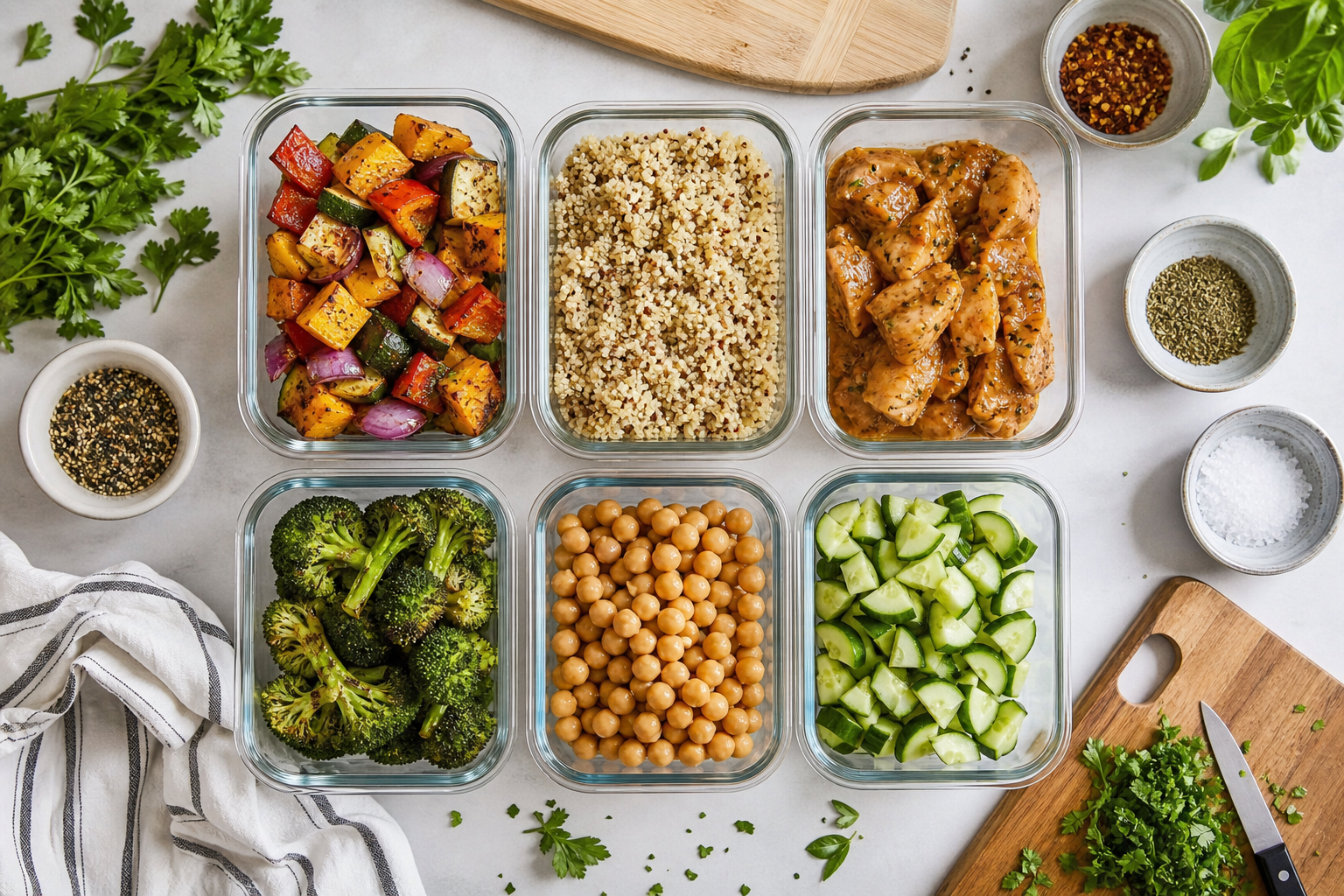
If you spend Sunday evening roasting a large tray of mixed vegetables, cooking a pot of grains (rice, farro, pearl barley), and marinating and cooking a batch of protein (chicken thighs, chickpeas, lentils), you don't have meals – you have components. Those components can be used in three or four completely different ways across the week: a warm grain bowl, a fried rice, a soup with the vegetable additions, cold lunch with greens and a dressing. The meals don't feel identical even though the base ingredients are the same.
This matters because one of the main reasons meal prep fails is that eating the same thing five days in a row is depressing. Ingredient prep removes that problem while still saving the time.
A Practical Weekly Framework
The Base Layer (Sunday, 45 minutes)
- A batch of grains: 300g of rice, farro, pearl barley or similar. Costs 5 minutes of active time; the rest is passive. Keeps 4–5 days in the fridge.
- A tray of roasted vegetables: Whatever needs using – root vegetables, courgette, peppers, red onion. 200°C (or air fryer at 180°C), 25–30 minutes. Minimal chopping required.
- A protein batch: Chicken thighs are the most forgiving (marinate for an hour, roast for 25 minutes, shred or slice). Lentils or chickpeas if you want a plant-based option (tinned chickpeas need no cooking; lentils take 20 minutes).
The Quick Additions (weeknights, 10–15 minutes)
With the base prepped, weeknight dinner becomes assembly rather than cooking. A few quick-cook additions that work well:
- Eggs in any form (fried, poached, or a simple omelette with the prepped veg folded in)
- Tinned fish (mackerel, salmon, sardines) – no cooking, high protein, good with grains
- Quick-wilt greens (spinach, kale) – 2 minutes in a pan with garlic
- A sauce or dressing made fresh – tahini with lemon and garlic, a simple tomato sauce, or just a good olive oil and something acidic
The Cost Question
| Approach | Approx weekly cost (2 people) | Active cooking time/week | Variety level |
|---|---|---|---|
| No meal prep (weeknight cooking) | £60–90 | ~5–7 hours | High (if you manage it) |
| Full Instagram meal prep | £40–60 | 3–4 hours Sunday + ~1hr weekdays | Low (same meals) |
| Ingredient batch prep (this guide) | £45–65 | ~1hr Sunday + 1.5–2 hrs weekdays | Medium–High |
| Mostly takeaway / deliveries | £100–160+ | Near zero | High |
What Makes It Fail
Starting too ambitiously. If you prep ten different things on Sunday, you'll run out of enthusiasm before you run out of food. Start with one grain, one vegetable thing, one protein. That's it.
Not having the right containers. Glass containers with snapping lids work better than whatever plastic bags and random Tupperware accumulates in most kitchens. Not expensive – a set of four glass containers costs around £15–20 from most supermarkets. Makes a genuine difference to whether things actually get used during the week or end up forgotten at the back of the fridge.
Trying to do it with a full-time shopping trip the same day. Prep works best when the shopping has already happened. Order the week's groceries on Friday or Saturday for delivery, do the prep on Sunday, start the week with a clear fridge and a plan.
The minimum viable approach
Each Sunday: cook 300g of rice (20 min passive), roast a baking tray of vegetables (30 min passive), marinate and cook 500g of chicken thighs (30 min passive). Active time is about 15–20 minutes. You'll eat distinctly better on Monday, Tuesday and Wednesday than if you'd done nothing, and it won't cost you your entire Sunday afternoon.