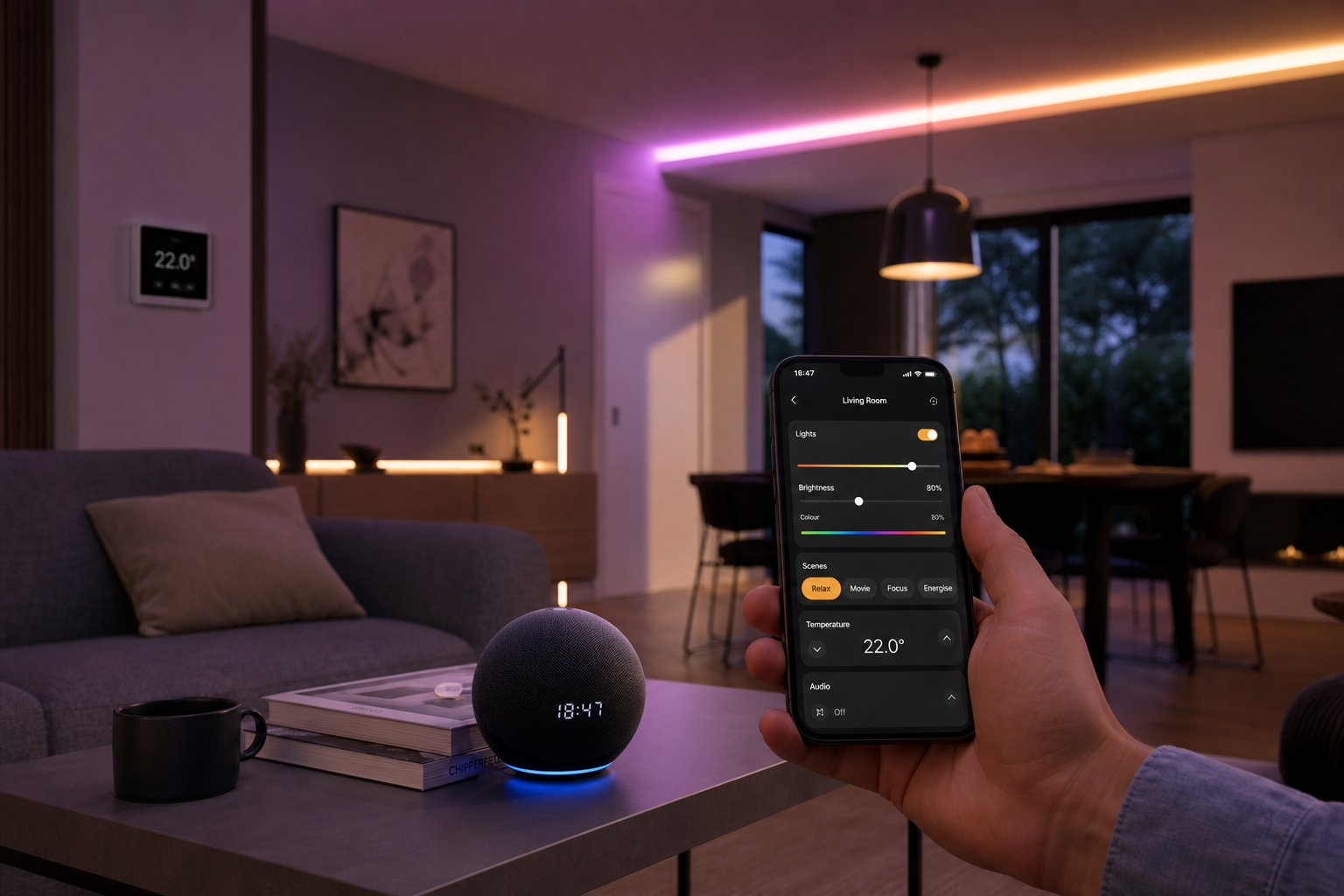
Two years ago I went fairly deep into smart home tech, partly out of genuine curiosity and partly because a house move gave me a clean slate to try things. I bought a range of devices, set up automations, and tried to turn my fairly ordinary semi-detached house into something you might see in a YouTube video.
What I found is that smart home technology exists on a very wide spectrum of usefulness. Some of it has genuinely improved my daily life and I'd recommend it without hesitation. Some of it created problems it was supposed to solve. And some of it simply made no practical difference at all despite working exactly as advertised.
What I Actually Use Every Day
Smart lighting (with some caveats)
This is the gateway drug of smart home tech and probably the most broadly useful category. Philips Hue remains the premium standard; IKEA TRÅDFRI and various Zigbee-compatible alternatives deliver most of the same functionality at a fraction of the price.
What actually gets used: scheduled dimming in the evening, a single button by the bed that turns everything off, and the kids' bedroom lights coming on gradually in the morning rather than suddenly. These three automations have stuck. The dozens of others I set up – colour changes based on time of day, lights reacting to music, various moods – lasted about two weeks before I stopped using them.
The caveat is that smart lights only work well if everyone in the house uses them properly. If one person keeps the wall switch off, the bulbs lose power and the whole system breaks. This is a genuine usability problem that the industry has partially solved with smart switches but never completely eliminated.
Smart doorbell
The Ring Video Doorbell has been in operation at our house for 18 months and is one of the few smart home devices that replaced a real frustration. Missed deliveries, knowing who's at the door before opening it, and being able to speak to someone at the door while upstairs or away from home – all genuinely useful. The motion detection and package alerts we ignored after about a month; there's too much notification noise.
The main downside: subscription. Most features work without the Ring Protect Plan, but video history requires it, and without history the value drops significantly. Add that cost to the device when calculating whether it's worth it.
Smart thermostat
The Hive Active Heating thermostat has saved us money on heating, though I'd qualify that by saying the savings mostly came from the first month of actually paying attention to our heating schedule and fixing obvious inefficiencies, not from any AI optimisation magic. A programmable thermostat that we'd set up properly would probably have achieved much the same result.
What I do use: remote control from a phone app, geofencing to lower the heating when the house is empty, and a holiday mode. Those three features are genuinely useful.
What's Gathering Dust
| Device | Cost | Problem it claimed to solve | Reality |
|---|---|---|---|
| Smart plug strips | £15–30 each | Control any appliance remotely | Used twice; most appliances don't need remote control |
| Smart coffee maker | £89 | Coffee ready when you wake up | Still need to fill with water and beans the night before – defeats the point |
| Smart home hub display | £129 | Central home control | Phone does this better; screen became a digital photo frame |
| Motion sensor lights (hallway) | £45 total | Automatic lights | Good concept, terrible sensitivity tuning – false triggers constantly |
| Smart air purifier | £149 | Auto-adjust based on air quality | Works fine; the smart features add nothing over a manual schedule |
The Pattern
Looking at what works and what doesn't, there's a fairly clear pattern. Devices that solve a specific, tangible problem that I actually had – missed deliveries, heating I couldn't control when away – have delivered real value. Devices that solve theoretical problems or add smart features to things that work fine without them have mostly been a waste of money.
The second pattern: anything that requires me to do something differently to get the benefit tends to fail. The coffee maker required planning the night before; it was actually more friction than my old kettle and cafetière. The smart hub required me to go to a specific screen; my phone was already in my hand. Automations that run without any intervention from me have a much higher survival rate than ones that require any behaviour change on my part.
If you're starting a smart home
Start with a smart doorbell if you have persistent delivery problems, a smart thermostat if you have complicated heating schedules or travel regularly, and smart bulbs for any lamp you have on a fixed daily schedule. Add slowly, only when you have a specific problem to solve. The ecosystem will still be there once you know what you actually need.
The compatibility situation between different ecosystems (Matter/Thread, Zigbee, Z-Wave, proprietary) has improved significantly with the Matter standard, but hasn't fully resolved. If you're building from scratch, buying within one ecosystem (Amazon, Google Home, Apple HomeKit, or Matter-compatible devices) will save considerable frustration compared to trying to mix and match.